

Article by Cllr Dick Cole published in the Cornish Guardian newspaper (16th October 2024)
On 16 July, less than ten days after Labour’s General Election victory, the five Group Leaders on Cornwall Council wrote to the Prime Minister with a request that Cornwall be invited to join his proposed Council of the Nations and Regions.
The letter to Keir Starmer stated that the “rationale for this request is based on the fact that, like the Welsh, Scottish and Irish, the Cornish people and the language are recognised and protected by virtue of two Council of Europe treaties. The first of those is the Framework Convention for the Protection of National Minorites and the second being the European Charter for Regional or Minority Languages. This legal recognition defines Cornwall as a nation by virtue of having a distinct language, history, ethnicity, culture, society and territory.”
The Group Leaders – representing Conservative, Independent, Liberal Democrat, Mebyon Kernow/Green and Labour councillors – also repeated the 2014 pledge from central government that the recognition of the Cornish as a national minority “now affords them the same status as the UK’s other Celtic people; the Scots, the Welsh and the Irish;” adding that “representation from Cornwall on the Council of the Nations and Regions” would honour the UK’s international obligations.
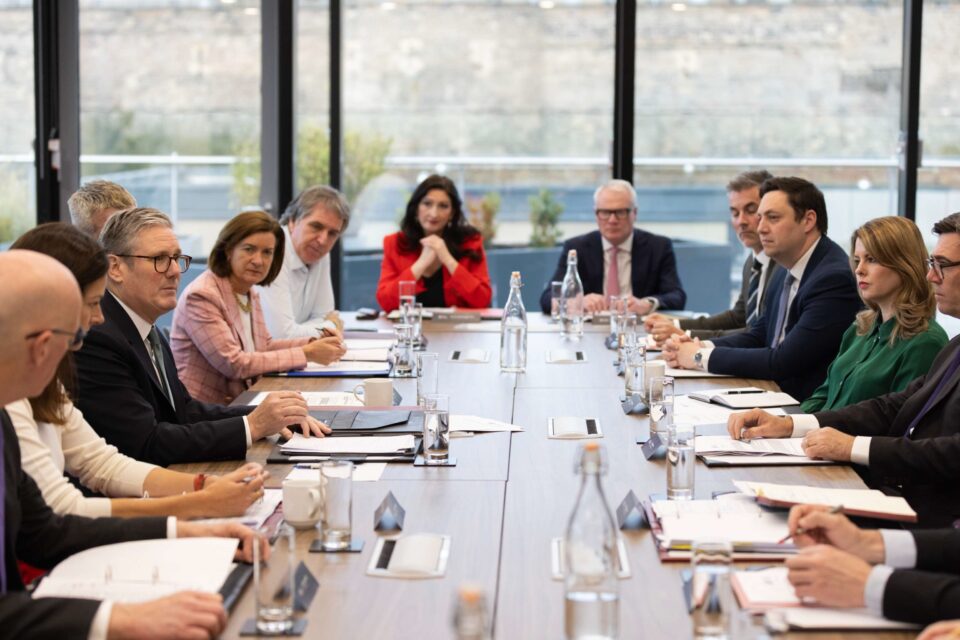
I can confirm that the unitary authority has yet to receive a response to the letter and the first meeting of this “quasi-intergovernmental body” took place in Edinburgh on 11 October. Cornwall was not represented.
In addition to the Prime Minister as the head of the UK Government, the initial make-up of this new body comprised the First Ministers of Scotland and Wales, the First and Deputy First Ministers of Northern Ireland (where there is a power-sharing Assembly), and 11 mayors from “combined authorities” in England, ranging from Manchester to the Tees Valley.
There has certainly been criticism about the asymmetrical nature of this new entity, and who is, and who isn’t, represented. Many Scottish politicians, for example, were quick to point out that, as England was not represented as a single political entity, Scotland was there on the same footing as regions or groupings of local councils to the south of the Tweed. Some also pointed out, conversely, that there were no representatives from Scottish regions. And in his last public statement on social media, the former First Minister of Scotland Alex Salmond, who died on Saturday, stated that the Scottish First Minister should not have attended and instead told the PM that “Scotland is a country not a county.”
But whatever the future holds for this “quasi-intergovernmental body,” and other mechanisms of state, Cornwall must be treated with respect as a coherent and historic part of the UK.